NEWS PLF PRESIDENT'S COLUMN MAJOR ISSUES  
POSITIONS SMALL TRACTS
PRESIDENT PLF MEETING
MORE INFO HOME
CONTACT US FEATURES
MEMBERS ARCHIVES
HISTORY NPLD
MEMORIAL OTHER LINKS
AWARDS MONITORING

THE PRESIDENT’S COLUMN

George Lea at: glea2@verizon.net

President's Letter on New Mexico Land Bill -- July 2, 2008

Congressman Nick J. Rahall II, Chairman Committee  Natural Resources, Room 1324 LHOB, Washington, DC  20515

Dear Chairman Rahall: We are writing to express our concerns with several aspects of the Doņa Ana County Planned Growth, Open Space, and Rangeland Preservation Act of 2008 (H.R. 6300), which was introduced and referred to the Committee on Natural Resources on June 18, 2008.

The Public Lands Foundation (PLF) is a national non-profit conservation organization founded in 1987.  Our membership is primarily retired former employees of the Bureau of Land Management (BLM) and as such represents a broad spectrum of knowledge and experience in public land management.  Our membership includes former BLM State Directors, District and Area Managers, and a wealth of experienced personnel in land and realty management and land appraisal.  Our mission is to keep America’s public lands in the public’s hands, sustainably managed for the public’s common use and enjoyment through professional, science–based education and advocacy.

BLM administered public lands are a national asset and a national “public land system” that should be retained in public hands for use and enjoyment by the American people and that should not be viewed as a source of funding for local projects, programs or purposes.The Federal Land Policy and Management Act of 1976 (FLPMA) provides that the BLM public lands are to “be retained in Federal ownership, unless as a result of the land use planning procedure provided for in this Act, it is determined that disposal of a particular parcel will serve the national interest.”  (Emphasis added).

PLF opposes special land disposal legislation which transfers large blocks of public land out of federal ownership and gives special privileges to local interests without regard to the requirements of existing statutes like FLPMA and the National Environmental Policy Act.Congress has equipped the BLM with adequate authorities to dispose of federal public lands where needed for local development and uses, and special land disposal legislation is, in most cases, unnecessary.

Title I of H.R. 6300 would establish two “special preservation areas” and provide a special prescription for management of these areas.Title II of the bill would establish four “rangeland preservation areas” and provide a different special prescription for management of these areas. BLM already manages land under numerous special designations—National Conservation Areas, National Monuments, Wilderness Areas, Wild and Scenic Rivers and more.  The use of these new and additional descriptors is ill-advised and will only lead to confusion within BLM, and with public land users.

We also notice that Titles I and II allow for the acquisition of non-Federal land from the state, local governments and non-profit organizations, but not from private landowners.  BLM should not be prohibited from acquiring private inholdings from a willing seller.  Thus, the acquisition provisions in these two titles should be amended to allow BLM to retain the acquisition authorities granted to it under FLPMA.

Title III provides for the consolidation of the surface and subsurface estates of certain lands belonging to New Mexico State University and BLM with a legislative conclusion that the values are approximately equal without the benefit of an appraisal.  Without an appraisal it is impossible to know whether this exchange is in the public interest or not.  What is the potential for oil, gas and mineral development in the subsurface estate?  What is the highest and best use of the surface estate to be exchanged?  We believe an appraisal should be required to assure both parties and the public that the exchange has merit.

Title IV provides for the disposal of federal land for community growth based upon recommendations from an advisory board that would be established by the bill.  It establishes a special account for proceeds, giving 10% of the proceeds to the County and 10% to local communities.  And, a portion of the remaining funds in the account are to be used for other than BLM purposes.  PLF opposes all of these provisions.  As stated earlier in this letter, PLF opposes special land disposal legislation which transfers large blocks of public land out of federal ownership and gives special privileges to local interests without regard to the requirements of existing statutes.  BLM has adequate disposal authority without the provisions in Title IV.  This title should be removed from the bill.

Thank you for considering our views and concerns.   Our membership is committed to seeing that the public lands are sustained, protected and managed in the public interest.Sincerely, George Lea, President Cc: NM SD


TESTIMONY - THE HOUSE APPROPRIATIONS SUBCOMMITTEE ON INTERIOR AND RELATED-March 13, 2008

AGENCIES- FY 2009- Bureau of Land Management-By George Lea, President, Public Lands Foundation

Thank you Mr. Chairman for this opportunity to present your committee with our views on the Bureau of Land Management's (BLM) budget request for FY 2009.  As a national, non-profit organization principally of retired but still dedicated former BLM employees, the Public Lands Foundation (PLF) has a unique body of knowledge, expertise and experience in public land management.  We are the only national membership organization dedicated solely to the protection and professional multiple use management of BLM public lands. As retirees, believe we can now offer an objective and non-bureaucratic view of what is really happening to the public lands and suggestions for improvement.  It is important that the Committee understand that while we are supportive of BLM and its programs, we are not a "captive" of the Bureau and are independent in our views.  Our mission's primary focus is on improving the condition of the land and its natural resources and keeping the public lands in public hands. We strive to improve the effectiveness of BLM by encouraging professionalism among employees and to increase the public's understanding of and support for the proper scientific management of these lands.

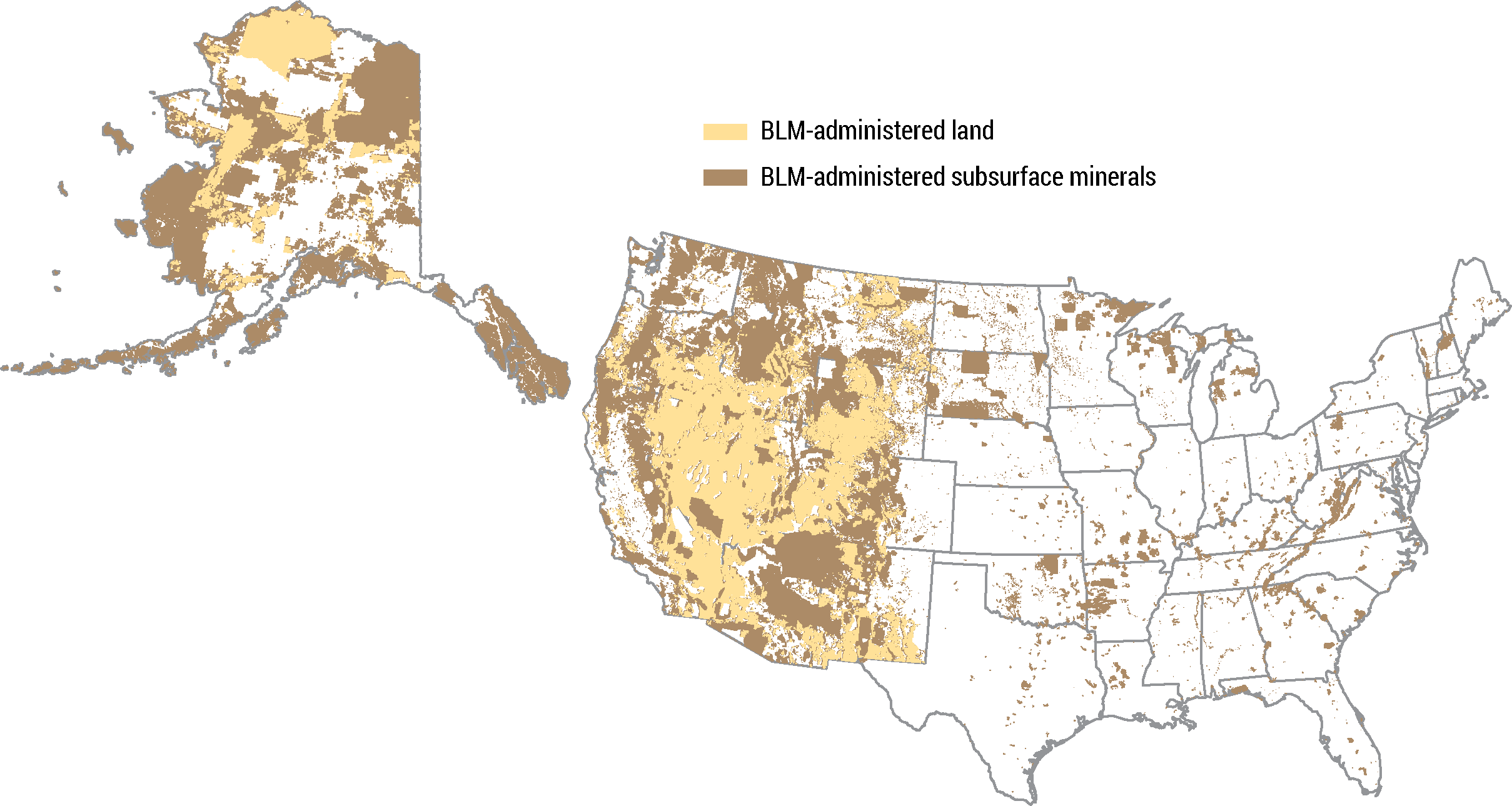
Overview-While the demands upon BLM public lands continue to increase, yet the total net budget request of $977.4 million, a decrease of $5.8 million from the 2008 level.   It is significant to note that BLM will return more than $6.2 billion in receipts in 2009, yes that is not a mistake but $6.2 billion, with 44% of the receipts returned directly to States and Counties to support roads, schools and other community needs.  We are unaware of any federal agency that returns such receipts compared with its budget.  BLM emphasizes inclusion of local input in the process of conserving the environment and is a model of President Bush's idea of cooperative conservation.  In addition to 258 million surface acres BLM, also is responsible for 700 million acres of federal mineral estate throughout the nation.  That is nearly a billion acres of precious assets making BLM the largest steward of Federal lands. We support the requested budget, particularly the increases to implement the Healthy Lands Initiative. However we see certain shortfalls in emphasis and/or the need for increased dollars in FY 2009 principally to increase staffing, in the following high priority programs, to enable the Bureau to adequately address urgent natural resources issues:

Personnel Needs

BLM's budget is directed towards the work force requirements needed to put trained natural resource specialists on the ground to manage the land. BLM's programs are labor intensive and do not lend themselves to contracting.  Any man-power or budget reductions will not only directly affect BLM's ability to properly manage and protect the public lands, but also would have a negative impact on the generation of receipts to the States, Counties and the US Treasury.   Budgets often contain the false assumption that, with a smaller budget and fewer personnel the workload will decrease and less work needs to be accomplished.  That is not the case for natural resources management agencies.  It is the constant need to protect the land and the natural resources and the public's increasing service demands that drive the budget requirements. For example the 2000 Census found the West to be the fastest growing region of the Nation; nine of the 12 fastest growing states are in the West where the growth rate averages 27% per decade more than twice the national average of 13%. To demonstrate this constant need to protect the land, more than 22 million people live within 25 miles of the land the Bureau manages and the BLM lands have become the outdoor recreation playground of the West.  In 2009, over 58 million visitors are expected to participate in recreational activities on BLM lands. BLM has always been the forgotten "step-child" in the family of Federal land management agencies and has never had the personnel needed to match its responsibilities. Once again we believe the Committee needs to know the personnel needs of BLM and should encourage BLM to develop a five-year program to bring BLM's work force to a level adequate to protect the resources and perform the work needed.

Healthy Lands Initiative- (+$5,000,000) We support a $15 million total increase for the Healthy Lands Initiative. Mr. Chairman, there is a lot of good work being done on the ground under this program, much of it in partnerships with private organizations, and we support a $5 million increase over the requested budget   This new program is directed towards lessening the impact of energy development and other resource use activities such as grazing, fire and recreation on the potential conflicts with the needs of wildlife and habitat conservation in six priority geographic areas.  To a large extent the areas to receive special consideration are the sagebrush dominated landscapes associated with managing at-risk species, such as the sage grouse, to prevent listing of the grouse and to better assure recovery for other listed as threatened and endangered.

Selling public lands- The 2009 BLM budget suggests legislation is needed to stimulate the selling public lands to help reduce the Federal budget deficit in 2009.  The PLF strongly objects to a policy of accelerated selling of the public lands. The Committee is reminded that the Federal Land Policy and Management Act (FLPMA) of 1976 contain adequate authority for BLM to sell lands. Reducing the federal deficit in any meaningful degree would require a massive disposal of the public lands, which the public will not support.  PLF does not support retaining all public lands in public ownership. There are scattered, isolated parcels of BLM lands that should be in private ownership, and there are BLM lands in the vicinity of growing Western cities and towns that are needed for urban expansion.  However, the bulk of the BLM lands have become the outdoor playgrounds of the West and the public has repeatedly and strongly opposed any large-scale disposal of the BLM lands. The BLM budget before this committee again proposes that the Federal Land Transportation Facilitation Act be amended to allow BLM to sell all lands identified suitable for disposal in all updated management plans.  FLPMA already provides BLM this authority.  However, the budget proposal would direct that a portion of the proceeds from   the sale of BLM managed lands be available for the acquisition of other non-federal lands (in-holdings) in national parks, refuges and monuments.  We object to using BLM lands as a "cash cow" in this manner. The public land system that BLM administers have the same importance and integrity as the land system managed by the National Park Service, for example, and that integrity needs to be respected. All federal land management agencies, including the Forest Service, have many lands that are difficult to manage and that could be sold.  Congress should provide the authority that these agencies need to sell these lands with the proceeds going to the acquisition of in-holding lands within that agency rather than to rely on selling BLM lands.

Wild Horse and Burros (+2,000,000)- The budget proposes a very modest increase for this program in FY 2009.  The Committee is reminded that once the wild horse and burro population levels is down to Appropriate Management Levels (AML), each year approximately 20%, the annual reproductive increment, of the population must be removed to keep the population with in the AML. BLM estimates they will have approximately 31,000 animals in contract holding facilities where the animals must be held until they die of natural causes.  BLM has no alternative.  This is ridiculous!  There are more animals held in these facilities than roam the public lands.  These holding costs consume over half of the BLM's wild horse and burro program ($18,000,000) each year and it keeps climbing. In previous years Congress has provided additional funding in order to remove animals for the public lands to reach the AML and it would be most unfortunate to not to provide an increase in FY2009

Range Improvement Fund-   The FY2009 BLM budget again proposes to eliminate the Range Improvement Fund ($10 M) to further deficit-reduction efforts.  Originally this proposal was based on the assumption that   the Department would change the grazing regulations to give title to range improvements to grazing permittees thus reducing the need for the range improvement fund and give the grazing permittee an incentive to bear the costs of such improvements.  As a result of a court decision, these regulations have noww been abandoned by BLM.  It should be noted that the current grazing regulations encourages grazing permittees to contribute towards range improvement projects and further protects a permittee's financial investment in improvements by authorizing a grazing permittee to be reimbursed for their financial contribution to range improvements should they loose the use of such improvements.  It is also important that the Committee understand that the Range Improvement Fund is not used exclusively to benefit the grazing permittee.  The fund is also used on high priority watersheds to maximize the potential for overall improvement and protection of those watersheds by improving the vegetation, habitat conditions and health of rangeland ecosystems to benefit livestock, fish and wildlife habitat, riparian values, watershed protection and other resource values.  The funds are thus not tied to an individual grazing permit or a specific grazing allotment but used for a rather wide variety of projects not necessarily benefiting directly a grazing permittee.  The benefits to the Range Improvement Fund out-weigh the small contributions to deficit reduction that eliminating the fund would make.  For the above reasons, the PLF does not support the budget proposal.

Oil and Gas Management-+($2,000,000) Increased funding to supervise oil and gas operations on the ground is needed over the increases granted in FY2008. According to a December 17, 2007 report by the Subcommittee on Royalty Management to the Royalty Policy Committee, which is chartered under the Federal Advisory Committee Act, BLM role in production accountability reviews needs to be strengthened to ensure that all royalties are being reported and collected properly.

Renewable Energy- + ($2,000,000) With the increase in the cost of energy and the need for alternative energy sources the number of applications for wind and solar facilities on public lands has mushroomed.  Currently BLM has a backlog of 137 solar and 173 wind applications awaiting BLM's actions. The Bureau need funding to process these applications and we suggest that the BLM be given the authority to retain the fee receipts from renewable energy applications as is the case with some of the other energy activities, i.e. Oil and Gas and Geothermal.

Illegal Immigrants Impacting Public Lands (+$2,000,000)-Undocumented aliens continue to cross from Mexico into the United States, crossing public lands administered by BLM, and continue to damage or destroy valuable natural and cultural resources, abandon vehicles, pollute with their trash and human waste, and create serious safety risks to employees and the visiting public. Increased funding is required to mitigate these damages, repair infrastructure, improve signage, and close mine shafts.  BLM is responsible for managing 8.8 million acres of borderlands.

Fire Fighting Funds--As the Committee knows BLM has historically borrowed funds from programs that carry over funds from year to year to pay fire fighting costs. The borrowed money is repaid through supplemental appropriations. This system has generally worked well. However, should these funds not exist, this would cause serious disruption of on-going programs. It is our understanding that the Forest Service has such a problem, as may other federal land management agencies. The procedures for funding fire suppression should be changed. The cost of funding fire suppression should be taken out of the agency's budgets and made available by a separate fire suppression fund

Recreation and Visitor Services Program (+$10,000,000) Despite the fact that recreation uses of BLM lands are increasing exponentially, the FY 2009 budget for this program proposes a substantial decrease. In many respects the recreational uses on public lands is a dominant feature on the landscape and a major element in the economy of the western states.  Issues related to increased urbanization of the west and continuous advances in technology, particularly motorized recreation and increased off-highway vehicle (OHV) use, have overwhelmed the many BLM field offices especially in fast growing urban areas.  Issues such as irresponsible target shooting, rampant OHV use, vandalism, trash dumping are generating considerable resource damage and visitor safety concerns. Increase funding is required to improve on-the-ground management of OHV, mapping and signing of roads and trails, and increasing law enforcement and BLM patrol efforts.  BLM's current recreation challenge-cost share program is one of the most effective in the Department of Interior, often leveraging resources and funding at about 4 to 1, sometimes even as great 10 to 1.

Cultural Resources- (+$3,000,000) We are disappointed to see the reduction in this important program particularly when the program received a long overdue an increase for FY2008.  We have been asking for the Congress for many years to recognize the extensiveness   and value of the public lands as a national storehouse of cultural and historic treasures. With the increase in recreational uses of the BLM lands, these cultural resources require constant protection, restoration and surveillance.

Cost Recovery- The 2009 budget again proposes to repeal provisions of Section 365 of the Energy Policy Act, which prohibits BLM from implementing cost recovery fees for processing APDs.  This change would allow BLM to make permanent the recovery of the cost of processing these types of applications. We support this change.   The total cost of processing a permit averages $4,500.  The industry objects to paying a processing fee, a minor cost that surely would not severely impact the financing of exploration nor reduce the number of permit applications.  More than 10,000 APDs are anticipated in 2009.

Fixed costs-We encourage the Committee to fully fund BLM's fixed costs.

Mr. Chairman, we hope these comments for priorities for BLM's FY 2009 budget request and our ideas for changes will be of value to your committee.  We remain sincere in our efforts to see the public's land managed well. George Lea, President

Supreme Court Rejects Robbins' Suit -- June 27, 2007

SUPREME COURT RULING ON WILKIE v. ROBBINS CASE--As you all may recall we have been very concerned that the Wyoming Rancher case before the Supreme Court could have profound implications on the ability of public land managers to perform their duties in the public interest should the government loose the case. We won!!

Today, the Supreme Court finally put an end to the nine-year saga of Harvey Frank Robbins' efforts to translate his disputes with the BLM's Worland Field Office into a federal racketeering lawsuit.  In largely-unanimous decision (two Justices dissented on certain issues), the Supreme Court rejected Robbins's last two remaining claims against seven current and former BLM employees, clarifying that the Tenth Circuit Court of Appeals erred when it held that Robbins was entitled to a trial on the question of whether the facts of his feud with the BLM translated into constitutional tort and racketeering liability.In today's opinion, the Court held that, even viewing the (unproven) facts Robbins's claims in the light most favorable to him, the defendant BLM employees could not be liable either under a constitutional tort theory or under the civil liability provisions of the Racketeer Influenced and Corrupt Organizations (RICO) statute. Robbins operated a cattle and guest ranch on private parcels and federal grazing allotments in an area of mixed private, federal, and tribal land ownership outside Thermopolis, Wyoming. Robbins had argued that a wide variety of actions - cancellation of grazing and special recreation permits, livestock trespass charges, criminal prosecution, alleged trespass - amounted to a conspiracy by BLM employees to force him to consent to granting an easement for the BLM to use portions of a road over his fee land. All nine Justices agreed, with relatively little discussion, that the RICO claim was unsustainable. Civil RICO claims must be predicated on actions that would constitute a felony under the criminal law. Robbins alleged that the predicate felony in this case was extortion - that the defendants attempted to extort a right-of-way from him through an alleged pattern of harassment.  The Court made short work of this interpretation of extortion, holding that government officials are liable for extortion if they improperly use their authority to extract something for personal benefit, but not when government officials, even if overzealously, seek property for the government itself. The Supreme Court's decision today finally brings an end to the cloud of potential personal liability that has been hanging over Mr. Wilkie and his colleagues for nine years, and vindicates the positions that National Wildlife Federation, Wyoming Wildlife Federation and the Public Lands Foundation have taken in amicus curiae briefs supporting the defendants.We thank the National Wildlife Federation for providing excellent pro-bono legal help by Michael Saul to PLF and the above analysis of the case George Lea,

April 19, 2007-TESTIMONY - THE HOUSE APPROPRIATIONS SUBCOMMITTEE ON INTERIOR AND RELATED AGENCIES– FY 2008- Bureau of Land Management By George Lea, President, Public Lands Foundation: Thank you Mr. Chairman for this opportunity to present your committee with our views on the Bureau of Land Management’s (BLM) budget request for FY 2008.  As a national, non-profit organization principally of retired but still dedicated former BLM employees, the Public Lands Foundation (PLF) has a unique body of knowledge, expertise and experience in public land management.  We are the only national membership organization dedicated solely to the protection and professional multiple use management of BLM public lands. As retirees, we believe we can now offer an objective and non-bureaucratic view of what is really happening to the public lands and suggestions for improvement.  It is important that the Committee understand that while we are supportive of BLM and its programs, we are not a “captive” of the Bureau and are independent in our views.  Our mission’s primary focus is on improving the condition of the land and its natural resources and keeping the public lands in public hands. We strive to improve the effectiveness of BLM by encouraging professionalism among employees and to increase the public’s understanding of and support for the proper scientific management of these lands. Overview: While the demands upon BLM public lands continue to increase, the total budget request of $1.8 billion, which is a modest $6 million increase over the 2007 actual level,  is a step backward.   It is significant to note that BLM will return more than $4.8 billion in receipts   in 2008, with 44% of the receipts returned directly to States and Counties to support roads, schools and other community needs.  We are unaware of any federal agency that returns such receipts compared with its budget.  BLM emphasizes inclusion of local input in the process of conserving the environment and is a model of President Bush’s idea of cooperative conservation.  In addition to 261 million surface acres BLM, also is responsible for 700 million acres of federal mineral estate throughout the nation.  That is nearly a billion acres of precious assets making BLM the largest steward of Federal lands. We support the requested budget, particularly the increases to implement the Healthy Lands Initiative. However we see certain shortfalls in emphasis and/or the need for increased dollars in FY 2008 principally to increase staffing, in the following high priority programs to enable the Bureau to adequately address urgent natural resources issues: Personnel Needs: BLM’s programs are labor intensive and do not lend themselves to contracting. BLM’s budget is directed towards the work force requirements needed to put trained natural resource specialists on the ground to manage the land.  Any man-power or budget reductions will not only directly affect BLM’s ability to properly manage and protect the public lands, but also would have a negative impact on the generation of receipts to the States, Counties and the US Treasury.   Budgets often contain the false assumption that, with a smaller budget and fewer personnel the workload will decrease and less work needs to be accomplished.  That is not the case for natural resources management agencies.  It is the constant need to protect the land and the natural resources and the public’s increasing service demands that drive the budget requirements. For example the 2000 Census found the West to be the fastest growing region of the Nation; nine of the 12 fastest growing states are in the West where the growth rate averages 27% per decade- more than twice the national average of 13%. To demonstrate this constant need to protect the land, more than 22 million people live within 25 miles of the land the Bureau manages and the BLM lands have become the outdoor recreation playground of the West.  In 2008, over 58 million visitors are expected to participate in recreational activities on BLM lands.  BLM has always been the forgotten “step-child” in the family of Federal land management agencies and has never had the personnel needed to match its responsibilities. Once again we believe the Committee needs to know the personnel needs of BLM and should encourage BLM to develop a five-year program to bring BLM’s work force to a level adequate to protect the resources and perform the work needed. Selling public lands: The 2008 BLM budget suggests legislation is needed to sell public lands to help reduce the Federal budget deficit in 2008.  The PLF strongly objects to a policy of accelerated selling of the public lands. The Committee is reminded that the Federal Land Policy and Management Act (FLPMA) of 1976 contains adequate authority for BLM to sell lands. Reducing the federal deficit in any meaningful degree would require a massive disposal of the public lands, which the public will not support.  PLF does not support retaining all public lands in public ownership. There are scattered, isolated parcels of BLM lands that should be in private ownership, and there are BLM lands in the vicinity of growing Western cities and towns that are needed for urban expansion.  However, the bulk of the BLM lands have become the outdoor playgrounds of the West and the public has repeatedly and strongly opposed any large-scale disposal of the BLM lands. The BLM budget before this committee proposes that the Federal Land Transportation Facilitation Act be amended to allow BLM to sell all lands identified suitable for disposal in all updated management plans.  FLPMA already provides BLM this authority.  However, the budget proposal would direct that a portion of the proceeds from   the sale of BLM managed lands be available for the acquisition of other non-federal lands (in-holdings) in national parks, refuges and monuments.  We object to using BLM lands as a “cash cow” in this manner. The public land system that BLM administers have the same importance and integrity as the land system managed by the National Park Service, for example, and that integrity needs to be respected. All federal land management agencies, including the Forest Service, have many lands that are difficult to manage and that could be sold.  Congress should provide the authority that these agencies need to sell these lands with the proceeds going to the acquisition of in-holding lands within that agency.Healthy Lands Initiative—We support the $15 million increase for the Healthy Lands Initiative.   This new program is directed towards lessening the impact of energy development and other resource use activities such as grazing and recreation on the potential conflicts with needs of wildlife and habitat conservation in six priority geographic areas.   To a large extent the area to receive special consideration is the sagebrush dominated landscapes associated with managing at-risk species, such as the sage grouse, to prevent listing of the grouse and to better assure recovery for those listed as threatened and endangered.  The six landscape sized area are located in southwest Wyoming, southern Idaho, Utah, southeast Oregon, northern Nevada, Colorado and western parts of New Mexico where declining health of sagebrush threatens to reduce access for energy development and other public uses such as recreation. National Landscape Conservation System (+18 million) This is a system of unique landscapes including 32 National Conservation Area, 15 National Monuments, 177 Wilderness Areas, 38 National Wild and Scenic Rivers and 12 National Scenic and Historic Trails. The Administrations FY 08 request is the lowest level of funding ever requested for this important program. It is important not only for the protection of the valuable resources involved, but also important for augmenting local economies that depend upon recreational uses of BLM lands. Increased funding is needed to develop partnerships with Gateway communities; increase number of Rangers for enforcement and resource protection; visitor management as the growth in visits increases exponentially and to enhance the science studies in the outdoor laboratory opportunities presented by these unique areas. Illegal Immigrants Impacting Public Lands (+4,000,000)—Undocumented aliens coming from Mexico into the United States and crossing public lands administered by BLM continue to damage or destroy valuable natural and cultural resources, abandon vehicles, pollute with their trash and human waste, and create serious safety risks to employees and the visiting public.  This increase in funding is necessary to implement BLM’s share of an interagency plan to mitigate these and other impacts caused by undocumented aliens crossing public lands in Arizona, California and New Mexico. Mining Law Administration (+22,000,000)— There is an urgent need to keep pace with the growing number of mining claims which require adjudication, notices which require review and plans of operations requiring BLM approval.  In 2005, 57, 494 new mining claims were filed due to the increase in gold prices and a renewed interest in uranium deposits on BLM land.  There are more than 320,000 active mining claims on BLM lands, not a small program.  The Mining Claim Location and Maintenance fee has risen to produce $54 million, yet the administration’s proposes to allocate only $32 million to handle this increasing workload. This is another example where reducing funding does not reduce the need to protect the land. Selling Subsurface Mineral Estate--   This budget reflects a proposal to fund BLM’s land acquisition program with a combination of appropriations from the Land and Water Conservation Fund and receipts from the sale of the subsurface mineral estate to the surface owner generating an additional $5 million.  Section 209 of FLPMA authorizes the selling of subsurface mineral estate “with no know value”. The Administration proposes an amendment to FLPMA to establish a minimum sale price of $10 per acre for this subsurface mineral estate.  Based upon our members’ experience, the $10 is much too low.  It is our view that a $20 per acre value would be more appropriate along with a 2% override royalty established to be held effective in perpetuity.  The American public owns this subsurface lands estate and no one can predict what the future may hold as to mineral values.  For example, some day stone and gravel may have values far exceeding other mineral values.It should be noted that to reach the expected $5 million level of receipts from the sale of the subsurface estate would involve selling 500,000 acres and would require increases in staff and funding for processing sale applications.Fire Fighting Funds--As the Committee knows BLM has historically borrowed funds from programs that carry over funds from year to year to pay fire fighting costs. The borrowed money is repaid through supplemental appropriations. This system has generally worked well. However, should these funds not exist, this would cause serious disruption of on-going programs. It is our understanding that the Forest Service has such a problem, as may other federal land management agencies. The procedures for funding fire suppression should be changed. The cost of funding fire suppression should be taken out of the agency’s budgets and made available by a separate fire suppression fund. Cultural Resources- (+4,000,000) We are disappointed to see the reduction in this important program particularly when the program received a long overdue an increase for FY2007.  We have been asking for the Congress for many years to recognize the extensiveness  and value of the public lands as a national storehouse of cultural and historic treasures. With the increase in recreational uses of the BLM lands, these cultural resources require constant protection, restoration and surveillance.Wild Horse and Burros (+4,000,000)- The Administration has imposed a $4.7 million reduction for FY 2008 based on the false premise that the projected wild horse and burro population levels would be down to Appropriate Management Levels (AML) by the end of 2007 and no longer need the funding. However, at this reduced level of funding, BLM would be able to gather only 300 animals, required in a court decision in Wyoming, and would not be able to remove the annual reproductive increment of 5000 to 6000 animals which must be gathered and adopted each year to maintain the AML. As of September 30, 2007, the BLM estimates they will have approximately 31,000 animals in long and short term holding facilities.  These holding costs consume over half of the BLM’s wild horse and burro program ($18,000,000).In previous years Congress has provided additional funding in order to remove animals for the public lands and to reach the AML and it would be most unfortunate to reduce funding at this point. Cost Recovery- BLM does not have the authority to implement cost recovery fees for Applications to Drill (APDs), Geothermal Permits to drill, geophysical and geothermal explorations permits.  The 2008 budget proposes to repeal provisions of Section 365 of the Energy Policy Act, which prohibits BLM from implementing cost recovery fees for processing APDs.  This change would allow BLM to recover the cost of processing these types of applications. We support this change.   The total cost of processing a permit averages $4,500, a cost that surely would not severely impact the financing of exploration nor reduce the number of permit applications.  More than 10,000 APDs are anticipated in 2008. Range Improvement Fund-The FY2008 BLM budget again proposes to eliminate the Range Improvement Fund ($10 M) to further deficit-reduction efforts.   A further stated justification is that the Department proposes to change the grazing regulations to give title to range improvements to grazing permittees thus reducing the need for the range improvement fund and give the grazing permittee an incentive to bear the costs of such improvements.  It should be noted that the current grazing regulations encourages grazing permittees to contribute towards range improvement projects and further protects a permittee’s financial investment in improvements by authorizing a grazing permittee to be reimbursed for their financial contribution to range improvements should they loose the use of such improvements.  It is also important that the Committee understand that the Range Improvement Fund is not used exclusively to benefit the grazing permittee.  The fund is also used on high priority watersheds to maximize the potential for overall improvement and protection of those watersheds by improving the vegetation, habitat conditions and health of rangeland ecosystems to benefit livestock, fish and wildlife habitat, riparian values, watershed protection and other resource values.The funds are thus not tied to an individual grazing permit or a specific grazing allotment but used for a rather wide variety of projects not necessarily benefiting directly a grazing permittee.  We believe it is important for the Committee to also appreciate the fact that the financial aspects of livestock grazing are normally not lucrative enough for permittees to pay for all the needed range improvements. The benefits to the Range Improvement Fund out-weigh the small contributions to deficit reduction that eliminating the fund would make.  For the above reasons, the PLF does not support the budget proposal. Fixed costs- We congratulate the Administration for including an increase of $30 million to fully fund BLM’s fixed costs. Mr. Chairman, we hope these comments for priorities for BLM’s FY 2008 budget request and our ideas for changes will be of value to your committee.  We remain sincere in our efforts to see the public’s land managed well. George Lea, President

SMOKE SIGNAL NO. # 8                                                  March 18, 2007

Re  Supreme Court Case, Wilkie v.  Robbins

If you have been reading our news letter, The Public Lands Monitor, or visiting our web site, www.publicland.org, you are aware of this legal dispute between a rancher Harvey Robbins and 6 BLM employees at Worland, WY, and our concern that the case could have substantial impacts on BLM’s ability to manage the public lands.  The case has moved its way forward and will be heard by the US Supreme Court on this coming Monday in Washington DC. To refresh your memory about this case: Robbins owns a private ranch, and uses federal public lands under grazing permits and a special recreation permit, outside of Thermopolis, Wyoming.  Since purchasing the ranch in 1994, Robbins has clashed with the BLM over access issues, road maintenance, and numerous trespass violations.  A controversial 2003 settlement resolving many of the BLM's trespass claims against Robbins was cancelled after Robbins continued to provoke additional claims of willful livestock trespass. Robbins filed the instant case, a Racketeer Influenced and Corrupt Organizations (RICO) action against six individual BLM employees, alleging that the defendants unlawfully violated RICO and the Fifth Amendment, specifically by (a) retaliating against him for the exercise of his right to exclude the BLM from his private property, and (b) by unlawfully attempting to extort the right-of-way across his private lands. The key concern here is that if employees of the BLM and other land management agencies may be subject to personal RICO liability based on the exercise of lawful regulatory authority, based solely on the allegation that their conduct was motivated by a desire to obtain a right-of-way or other benefit for the government, agency employees may be deterred from exercising their proper, lawful regulatory authority.  In other words, BLM employees facing a discretionary decision whether or not to take administrative action against a grazing permittee for repeated livestock trespass or permit violations may be deterred from taking such action by the threat of personal (and substantial) RICO liability. PLF has filed a joint Amicus brief with the National Wildlife Federation and the Wyoming Wildlife Federation supporting the BLM employees thanks to the pro bono council help at Weil, Gotshal and the National Wildlife Federation attorney.  The US Attorney General is representing the BLM employees involved. There is nothing more PLF can do at this point but to hope the court rules in favor of the BLM employees. The main purpose of this email is to alert you to the case and that the CBS is to air news articles this evening, Sunday March 18. The LA Times is working on a story and there may be others, George Lea, President

This is our 20 th anniversary.Yes on November 30, 1987 we were incorporated in the State of Virginia as a non-profit corporation. Thanks to the strong concern for the land   and financial support of our loyal members, now more than 1100, we are still hanging in there doing what we can to see that the public lands are kept in public hands and that the natural resources of the lands managed by BLM are managed following the principal of multiple use and sustained yield.  We believe we have become and effective voice in promoting the proper use and conservation of BLM administered lands; in encouraging professional and scientific management of the lands and are participating in efforts that will sustain the land’s health, diversity and productivity while encouraging co ntacts between BLM retirees.  We thank everyone who has  helped us along the way  and look forward to the next twenty years

We especially welcome new Board members: Pete Culp-Director (3 year), Eric Janes- CO Rep, Deane Zeller and Gardner Ferry- ID Reps, Dave Mari- MT Rep, Frank Splendoria- NM Rep.

2008 budget- BLM's budget request for FY 2008 is $1.8 billion which includes a $15.0 million increase to implement a new Healthy Lands Initiative and an increase of $3.1 million for oil and gas inspection and monitoring activities. The budget includes a proposal to use receipts generated from the sale of the subsurface mineral estate for acquisition of easements and land. This proposal is to help support a goal to unify estates with sales to current landowners . Also included is a $801.8 for wildland fire management. The budget request includes an increase of $32.6 million for suppression and continues a robust program for hazardous fuels reduction. Also included is a request for $40.4 million to continue deployment of the Financial Business Management System. Interestingly the Forest Service budget has a proposal to sell FS land identified in their land use plans as available for disposal to help pay for rural schools. BLMs budget again this year proposes to include all land use plans that identified lands for disposal with the proceeds for selling available for the acquisition of other non-federal lands within such areas as national parks, refuges and monuments. I am beginning to develop PLF's budget testimony to be given some time in March and there may be more "hidden" problems as I study the budget request further. Any thoughts would be appreciated.

2006 Outstanding Professional Award Ceremony- Tomorrow afternoon we have our awards ceremony scheduled in the Director's Conference room where we will recognize Joe Kraayenbrink, Idaho Falls District Manager as our Manager of the Year and Rick Hanson, Recreation Planner at the Phoenix District Office as our Technician of the Year. Prior to the ceremony I will tour them around DC to "show them off" to several national organizations and Hill staffers.

2007 annual meeting at Santa Fe- Ron Fellows and his meeting committee are making good progress on local arrangements and the meeting program. Our theme for the meeting is "Keeping Public Lands In Public Hands". It should be another good one. Please mark your calendar now and plan to attend, October 23-27, 2007. Check the next Monitor for more details.

New PLF members- Please help me attain my goal of 200 new members in 2007 by finding new retirees and interested working BLMers and giving them a free one year membership. Just send us their names and addresses. It is simple.

That's it for now and congratulations to all and welcome to our new Board members. George

Selling public lands --

On May 10 the House Appropriations Committee killed the Administrations’ proposal (thanks in no small measure to PLF members who let their representative know their view of such proposals) to sell BLM lands to reduce the budget deficit. However this land sale may well resurface during this session of Congress or the next for that matter or it may take different routes. For example Congressional representatives in Idaho and Utah have introduced bills into Congress, which would sell and transfer significant amounts of federal land, mostly BLM land, to individuals or local and state governments.  A notable change in tactics has emerged in these new bills.  It is known as the “Quid Pro Quo Template” where in exchange for designating wilderness area, BLM lands are sold or transferred out of federal ownership.  The PLF supports the establishment of new formal wilderness areas but not as part of “horse trading “ with BLM lands.  Wilderness legislation should be considered, as in the past, strictly on the merits of the wilderness quality of the area and not as a “Trojan Horse” for selling public lands. Equally the disposal of public lands should be addresses for the merits involved as developed through the planning system and not as part of a quid pro quo wilderness   In addition FLPMA and BLM’s land use planning system both have set the nation’s policy for the disposal of public lands and the establishment of wilderness areas.  Those processes should be allowed to proceed from the bottom up and not circumvented top down, by Congress.   Congress’s role in all of this is to establish the policy for land disposal as has been done in FLPMA and the establishment of wilderness areas in the Wilderness Act. There have been several cases of quid pro quo wilderness (or maybe it is in reality a quid pro quo public land disposal) areas.  The most recent quid pro quo wilderness was the Lincoln County Conservation, Recreation and Development Act of 2004 in Nevada to establish 768,000 acres of wilderness north of Las Vegas while trading off water pipelines rights-of-ways across public lands, conveying over 18,000 acres of BLM lands to the County, and selling 100,000 acres of BLM lands to the highest bidder.  The “slippery slope” to disposal of public lands we have spoken of is getting wider and slipperier.  We do not support retaining all public lands in public ownership.  However, what is needed is a comprehensive analysis of a BLM land tenure plan that is thoroughly and openly debated on a national scale before proceeding further with a quid pro quo BLM land disposal program.   


SMOKE SIGNAL              No. 7- February 19, 2006

“Never doubt that a small group of thoughtful committed citizens can change the world.  Indeed, it’s the only thing that ever has” Margaret Mead

SELLING THE PUBLIC LANDS TO REDUCE THE BUDGET DEFICIT

PLF Members: Well, the fat lady has not sung and the title to this Smoke Signal has not changed from the last one and this administration is still determined to sell off the BLM lands.   This time it is to somehow reduce the federal budget deficit rather than reduce expenditures. And this time it is the White House not just a Congressional Committee making the proposal. I warned you not to forget about this subject and to be alert to additional efforts to dispose of BLM lands.  And sure enough the 2007 budget, just released following the President’s State of the Union Message, contains a Legislative Proposal that would do just that.

As background:  The Southern Nevada Public Land Management Act which authorizes the sale of the very expensive BLM land in the Las Vegas Valley has of late been generating receipts far greater than ever anticipated which has sparked the interest by the Administration that the sale of public lands could help reduce the federal budget and also to spread the receipts to other states and not solely to Nevada.

In 2000   “The Baca Ranch Bill” became law for the purpose of transferring the ownership of a private ranch in New Mexico to the Forest Service to administer as an ecological reserve.  This law is titled the Federal Land Transaction Facilitation Act (FLTFA).  Hidden deep in that bill was a provision directing BLM to sell over 1 million acres of public lands in New Mexico that had been identified in land use plans for disposal.  The BLM liked it because 30% of the receipts from the sales were to be returned to BLM for acquiring inholdings in National Forest, Nat. Parks and Refuges and with in BLM land areas.  Our Smoke Signal No 3 on 4/14/2000, (which I am sure you no longer have) alerted you to this bill.  We objected to the bill.  However it became law and the precedent (policy) was established to sell public lands, beyond the Las Vegas Valley area, to augment the federal treasury.

Then, as you will recall, just last November the House Resources Committee tried to amend the 1872 Mining law to permit miners to buy the public lands within their claims for just the surface value.  Smoke Signal No 6 alerted you to this and with your help the measure was dropped from consideration (for the present) but not before the administration received a lot of poor publicity for their try to “give away” public lands.  We are therefore surprised to see this proposal in the 2007 budget, thinking they had learned a lesson, but apparently not.  This new budget deficit reduction proposal would amend FLTFA extending its application to all BLM lands with 70% of the proceeds from the sales going to the Treasury and capping the annual receipts retained by the Interior Department.  The 2007 budget also proposes to sell Forest Service lands, but this time to, help county school systems funding.

I urge you to contact all of your Congressional Representatives and Senators asking them not to sponsor or cosponsor legislation proposed in the 2007 budget that would sell BLM lands as a way to reduce the federal deficit.   We do not support retaining all public lands in public ownership. As you recall FLPMA provides the authority and policy for sale or exchange.   However there needs to be a comprehensive analysis of a BLM land tenure plan developed that is thoroughly debated before proceeding with the aggressive policy of public land disposal contained in the 2007 Administration’s budget.  George Lea, PLF President


Public Lands to be sold for Debt Relief

The Southern Nevada Public Land Management Act (SNPLA) has brought in so much money, almost $1.8 billion in the last couple of years, that the Administration has proposed to take 70 % of the land sales receipts and send it to the US Treasury to pay down the ballooning federal deficit.  SNPLA became law in 1998 to authorize BLM to sell land needed for town expansion around Las Vegas.  The law provides for the State of Nevada and local governments to receive 15% of the proceeds for water resource projects and parks and 85% is allocated the federal agencies for acquisition of conservation land around the state.  This new policy to sell our national assets to reduce our national debt is of course dumb and short sited.  To reduce the deficit, first expenditures should be reduced and brought under control.  And as expected other counties in Nevada and other states such as Idaho are considering similar measures. And so once again the public lands are looked upon as the “Cash Cow”, as an unlimited source of new money.  It wasn’t too many years ago that the then current Administration proposed to sell public land assets as a quick way to cover the expanding federal debt.  Those efforts, after many millions of federal dollars were spent in going through the motions to do so faded away, but not forgotten.  Lets hope this current try will also go nowhere.  There will be special situations as in the case of Las Vegas, that surrounding public lands would be better in private ownership.  The Public Lands Foundation is committed to keeping the public lands public and available for all the citizens to enjoy. 

Energy  

Within the last few years the pace of exploration for natural gas and coal bed methane has exploded. The well density planned is beyond what anyone has considered and the geographical scope may stretch along the entire Rocky Mt Front, from Montana to New Mexico. For example, the Powder River Basin is looking at more than 50,000 coal-bed methane wells being drilled just for gas in the immediate future or in Meeker, Colorado over 1900 wells are planned in 2004. The total number of wells planned in the Front Range area is unknown. We could be talking about a 40-acre gas field stretching from Wyoming south to New Mexico. Unless public opinion forces the administration to back off and let BLM start managing this development with large spacing like 640 acres or more with directional drilling from one pad, the Rocky Mountains will be one huge industrial zone similar to the congested oil fields of Texas. The sheer magnitude of the surface disruption from well pads, roads and pipelines, to say nothing of the traffic, air quality and water quality degradation, and the lost of other uses of the land, will far surpass anything we've ever dreamt of. It is mind-boggling. The new proposed energy bill calls for the oil & gas industry to be exempted from the Clean Water Act. They are already exempt from the Hazardous Materials Act. Also the only way to produce coal bed methane is to dewater the formation to release the gas. All this poor quality water must be dealt with in an environmental sound manner.

Gas companies are planning a drilling program based on 5 to 10 acre down-hole spacing. Directional drilling should be required, particularly on deep structures, but neither the land management agencies nor State regulatory agencies seem inclined to require directional drilling until the surface spacing gets down to 20 acres. At that spacing there is 660' between the well bores. Subtract another 300' of disturbed ground-150' from the well bores-for the well pads, subtract another 100' for cuts and fills and we're talking just roughly 300' of undisturbed ground between well sites. Of course this doesn't include the access roads and pipelines. Directional drilling is a perfected technology that has improved tremendously within the last 5 years. .

The biggest objection is that it’s a new way of doing things. However, some companies are used to directional drilling and do not have a problem with it. In many cases these companies use it a lot, without agency requirements, because they save money with every directional hole because of the savings from pads, roads etc they don’t have to build. This is with off the shelf technology.

BLM has got to start managing this gas exploration. They can’t just react to whatever the gas industry asks for and give it to them.

UPDATE ON MAJOR PUBLIC LAND ISSUES

SMALL TRACTS

The Privatization Scheme

The national argument over whether the public lands would be better off if the lands where in private hands continues today but on a new course. Those who support such changes have not been successful and so they seek new ways to realize their vision of privatizing the public domain. Reducing the public’s ability to review of decisions is one tactic. But there is another scheme sweeping through government today. If they can’t privatize the land, perhaps they can realize the same objective by privatizing the land’s managers. Today’s effort to privatize is called "outsourcing". The current administration’s effort is called "The Competitive Sourcing Initiative" which, as a beginning, directs federal agencies to identify federal employees who perform "commercial" activities to compete for their positions with the private sector. The Office of Management and Budget defines commercial activity as anything that can be, could be, or should be contracted. With such a broad definition, all BLM employees could be required to compete for their employment and could potentially be preformed by private contractors. Currently BLM is examining "maintenance" positions but all BLMers could be scheduled and will be in time. In a typical BLM field office all employees except perhaps the office manager could be considered "inherently government" employees. The staff of natural resource managers, forester, fisheries biologist, land surveyor, minerals manager or rangeland manager, according to the guidelines could be performed by a private sector company. Is the private sector ready to take over these functions? Oh yes. Just as an example, they would love to take over the rangeland manager’s or the fisheries biologist’s job. Sure, the private sector has biologists, foresters and other technically trained staff who could fulfill many of the functions carried out by federal workers. But federal employees are governed by binding and enforceable rules of ethical conduct while private contractors are not. Ethical conduct rule prohibit federal employees from accepting gifts or bribes. No such prohibitions apply to consultants. Federal employees are barred from making decisions they might financial profit from, nor give preferential treatment to anyone, nor hold outside employment that creates a conflict of interest, nor accept compensation from persons affected by decisions. No such prohibition applies to consultants. The proponents of privatization may not believe that ethics are important. The likes of Enron and its ilk would indicate this to be the case. Who do we want to manage our public lands; workers who are required to place the public interest first or workers whose first loyalty is the agency that hires or fires them?

The recently enacted Healthy Forest Initiative contains the encouragement for the BLM to contract such programs as the collection of range monitoring data for a District Manager to use in adjusting grazing use. Few managers would not want to nor should they make decisions based on such data.

But an even more serious consideration comes into play here. So let’s say we do privatize our forest and rangeland positions, and for example, the administration changes and the outsourcing policy is dropped or the contractor decides they want out, or the availability of contractors dries up for what ever reasons, then what does BLM do? They have lost the expertise and must start over to hire, train, etc.

Oh, and who is it that pays the bill for profit oriented consultant contractors?

One has to wonder what’s this all about. Is there something bigger going on here? We believe there has to be because on the surface it does not add up. Outsourcing does not appear to be motivated by national budget savings or efficiency. What ever the rational behind outsourcing is, the government ought not jeopardize the public land and natural resources by turning the management over to private run-for-profit companies.

Need for a National Public Land System

In March, 2000, Secretary Babbitt established a new land system of areas that parallel the park and refuge system. He directed BLM to set up a new office to provide guidance for the BLM's National Landscape Conservation System (NLCS). Although the BLM has different types of Congressionally and Presidentially designated units, they have not, until now been identified as a "system". To guide the management of the NLCS a National Landscape Conservation System Office (NLCSO) was established in the Washington Office reporting to the Director. This office was to give the BLM the opportunity to provide focused direction and budget coordination for the over all system. The land units will continue to be managed by the Field office managers.

The PLF has supported of the establishment of this new land system composed of 7 National Monuments (at this time) containing 3.3 million acres, 8 National Conservation Areas containing 2.2 million acres, the 9.5 million acre California Desert Conservation Area, the .7 million acre Headwaters Forest Reserve in California. 1.0 million acres in 35 Wild and Scenic Rivers, and 1,238 Wilderness Areas of 5.2 million acres. Several Historic Trails and National Scenic Trails are also included in the NCLS. All in all the NCLS takes in perhaps 15% of all BLM managed public lands.

Our greatest concern at this point is that there is a distinct potential to downgrade or throw up for grabs the other 85% of BLM public lands that are not presently included in the new land system. If this results in the majority of the BLM lands as being seen by the public as second rate or not worthy of being included in a national land system, it will be a disaster. By placing only certain areas in the NLCS we create the public impression that the remaining majority of the BLM lands are "not so special" and that could revive the efforts to transfer the large area of the not so special BLM lands to state and private ownership. The special areas in the NLCS should be the "Jewels in the crown" of a national public lands system managed by the BLM, not a stand alone system scattered throughout an anonymous expanse of public domain land that lacks an identity with the public can relate to and support for keeping it in public ownership an open to public use and enjoyment

We believe, therefore, that the success of the NCLS will be in how it is publicly perceived and understood. If it is a "stand alone" organizational unit it will be a failure. However, if it is seen, as we hope it is intended, that is as one part of the Public Lands of the United Sates managed by the BLM under the principals of Multiple Use and Sustained Yield as set forth in the Federal Land Policy and Management Act (FLPMA), and the public understands that these designated areas are some but not all of such special areas of the BLM public lands and that the NCLS is a part of that overall land system, then NCLS could be a significant step in the paradigm shift in understanding and using our public lands that began in the early 1960's and was spelled our in FLPMA.

A very important element in this public perception will be any logo or symbol used in connection with the NCLS. It our view that there is no need for such a separate logo because the public must never be allowed or induced to think that NCLS is anything other than a subset of BLM and the National Public Lands managed by BLM. The idea that NCLS designations are a sound and appropriate part of multiple use management must be encouraged. Whether we like it or not perception is reality and BLM is engaged in a process of shaping perception. In that process symbols play a critical part and we urge the BLM not to create the image of the NCLS as a separate stand alone organization.

We call on the new Administration to establish a "National Public Lands System" for all of the BLM lands as a way for this Administration to leave a Legacy for the Land.

YOUR HELP IS NEEDED

If you believe public lands should be protected and that all the natural resources found on these lands should be managed professionally in the best interest of the public, the owners of the land, please consider a tax exempt contribution to the Public Lands Foundation. All Foundation Board of Directors and Officers serve as volunteers without compensation. We do not hire professional fund raisers nor consultants and 100% of your contributions go to program services. You may use the following secure give button.   Give ButtonPlease note that we use a non-profit vendor to process your secure credit card transaction. For more information please contact me at my email address: leaplf@erols.com.


Return to PLF's Front Page


COMBINED FEDERAL CAMPAIGN- CFC #11786

Attention BLM employees and PLF members. The Public Lands Foundation is again a part of the 2008 Combined Federal Campaign. Again this year we have adopted an assumed name, called a “doing business as (d.b.a)” name of “Conservation and Protection of Public Land. However this year we have a new CFC number.  It is 11786.  So look for us under this name at our new CFC number.  We have adopted this new name just for CFC efforts in that our formal name of Public Lands Foundation does not describe to an uninformed person what it is that PLF does.  We believe this d.b.a. will help do that.  We are still affiliated with the Conservation and Preservation Charities of America, a group of 30 national organizations, all dedicated to conserving and preserving the natural resource of our country.  We ask current BLM employees to look for PLF in the CFC Catalogue, CFC # 1176, when the 2008 campaign begins this fall.  The working children and grand children of PLF members can also find us listed in both the United Fund and CFC.


Last Edited: March 22, 2008